Assessment of Grain Micronutrient Concentrations in Bread Wheat Generations under Early Heat Stress and Timely Sown Conditions
Meghana Singh Rajotia *
Department of Genetics and Plant Breeding, College of Agriculture, CCS Haryana Agricultural University, Hisar, Haryana, India.
Om Parkash Bishnoi
Department of Genetics and Plant Breeding, College of Agriculture, CCS Haryana Agricultural University, Hisar, Haryana, India.
Yogender Kumar
Department of Genetics and Plant Breeding, College of Agriculture, CCS Haryana Agricultural University, Hisar, Haryana, India.
Kautilya Chaudhary
Department of Soil Science, College of Agriculture, CCS Haryana Agricultural University, Hisar, Haryana, India.
*Author to whom correspondence should be addressed.
Abstract
Background: Wheat grain micronutrient deficiencies, particularly of iron and zinc, remain an important nutritional concern, highlighting the need for biofortification of widely consumed staple crops. Grain micronutrient accumulation is influenced by both genetic and environmental factors, including heat stress, making the identification of mineral-dense and heat-tolerant wheat genotypes important for breeding programmes.
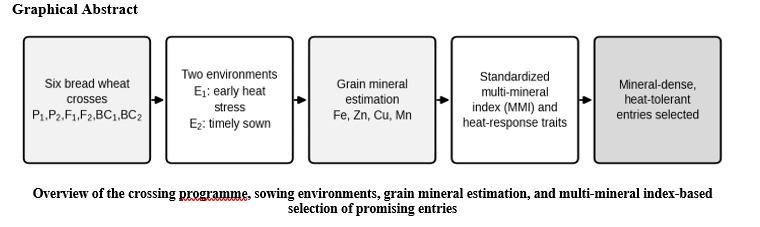
Aim: This study assessed grain iron (Fe), zinc (Zn), copper (Cu) and manganese (Mn) concentrations across six bread wheat crosses and their P₁, P₂, F₁, F₂, BC₁ and BC₂ generations under early heat stress and timely sown conditions, and identified entries with potential for mineral biofortification breeding.
Study Design: Six wheat crosses, each represented by six generations (P₁, P₂, F₁, F₂, BC₁ and BC₂), were evaluated in a randomised block design with three replications.
Place and Duration of Study: Research Farm, Wheat and Barley Section, Department of Genetics and Plant Breeding, CCS Haryana Agricultural University, Hisar, India; Rabi 2024-25.
Methodology: Grain Fe, Zn, Cu and Mn were estimated by microwave-assisted acid digestion and atomic absorption spectrophotometry under early heat stress (E₁, sown 25 October 2024) and timely sown (E₂, sown 22 November 2024) environments. A standardised multi-mineral index (MMI) was computed from mineral z-scores, and its association with yield and heat-response indices was examined.
Results: All four minerals showed exploitable variation across generations and environments, with concentrations consistently higher under early heat stress. The F₁ generation recorded the highest mean concentration for all four minerals and the highest MMI. Fe, Zn and Mn were positively interrelated, while Cu showed the strongest association with heat resistance and yield-related traits.
Conclusion: PBW 872 × DBW 327 was the most promising cross for broad-spectrum mineral enrichment, while DBW 187 × DBW 327 combined elevated Cu with superior heat tolerance. Selected hybrid and backcross entries from these crosses are recommended for further selection and validation in wheat biofortification breeding programmes.
Keywords: Bread wheat, grain micronutrients, biofortification, early heat stress, iron, zinc, copper, manganese, multi-mineral index, heat resistance index